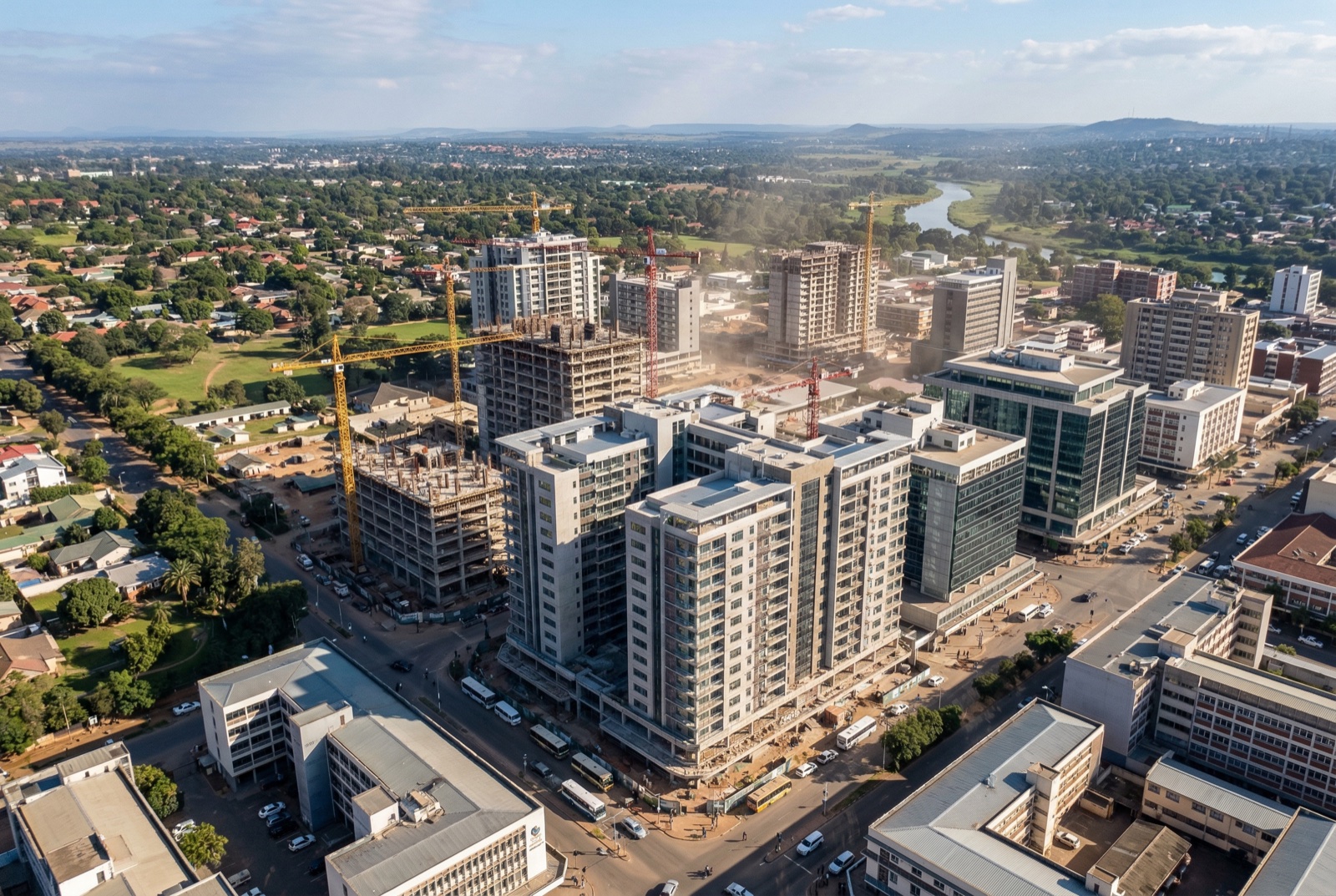
After two years of RTGS dollars, Zimbabwe's property market is reverting to what buyers and sellers always knew: USD is the only currency they trust. Following June 2020's Statutory Instrument 185, which effectively re-legalized multi-currency use, property transactions are moving back into US dollar territory — and the implications for buyers, sellers, and landlords are significant.
Zimbabwe's experiment with a mono-currency economy lasted less than eighteen months. When the RTGS dollar was introduced in February 2019 and subsequently rebranded as the Zimbabwe dollar (ZWL), the government's intention was to restore a functioning local currency after a decade of dollarization. The market's verdict on that experiment is now clear: annual ZWL inflation hit 785% by mid-2020, measured on an annualised basis, and the currency lost value so rapidly that any transaction priced in it became a negotiation about which exchange rate to use rather than about the underlying asset.
For the property sector, this was paralyzing. How do you price a house in a currency that is losing half its real value every few months? How do you agree a lease term when the rent that seems fair today will be economically meaningless in six months? The market did not solve these problems — it largely stopped functioning, or continued in a kind of shadow-USD mode in which prices were quoted in ZWL but everyone understood the USD equivalent was what was being negotiated.
Statutory Instrument 185 of 2020 changed the legal basis for what the market was already doing informally. Here is what it means for Zimbabwe property.
What SI 185 Changed
Statutory Instrument 185 of 2020, gazetted on June 26, 2020, amended the Exchange Control Act to re-permit the use of foreign currencies for domestic transactions. In plain terms: it became legal again to price, invoice, and settle transactions in US dollars within Zimbabwe.
This was not a trivial policy reversal. The 2019 mono-currency decree had made USD-denominated domestic transactions technically illegal, even as the economy continued to use USD through various informal channels. SI 185 removed that legal ambiguity. For the property sector specifically, it meant that sale agreements, lease agreements, and rental invoices could openly specify USD as the settlement currency — and courts would recognise USD obligations as enforceable.
The implications went beyond legal formality. SI 185 gave banks the authority to operate USD accounts for businesses and individuals in a more regularized way than had been possible under the mono-currency regime. It opened the door for sellers and landlords to formally demand USD settlement without risk of regulatory sanction. And it provided the legal foundation for the price repricing process that the property market needed to undergo: moving from ZWL-denominated asking prices — which had become functionally meaningless as real-terms reference points — back to USD denomination, which buyers and sellers could actually use as a planning tool.
How the Market Had Changed by Late 2020
By the time of writing in November 2020, the transition in Zimbabwe's property market is well underway, if not yet complete. The visible signs are consistent: property portals are increasingly showing USD prices rather than ZWL prices, or are showing both with the USD figure as the primary reference. Real estate agents who spent the 2019 period trying to maintain ZWL asking prices — adjusting upward monthly or weekly to track the black market rate — have largely abandoned that exercise and reverted to USD quoting.
The repricing process has created something interesting: a window of genuine value for USD buyers. Properties that were listed in ZWL terms at notional values equivalent to, say, $300,000 USD at some earlier official rate have been repriced at $180,000–$220,000 in USD when sellers acknowledge what hard-currency buyers are actually willing to pay. The ZWL depreciation effectively created a 20–40% discount on USD-denominated property values relative to where those same properties were priced pre-2019. For buyers holding US dollars — whether diaspora remittances, foreign-denominated salaries, or legacy savings — this is a meaningful acquisition opportunity.

Land transactions moved fastest of all. Land — particularly undeveloped residential stands in Harare's northern and eastern corridors — has been among the first asset classes to reprice firmly in USD, reflecting both the relative simplicity of land valuation and the fact that land developers require hard currency to fund infrastructure installation. If you are buying bulk land from a developer to build, you are almost certainly being quoted in USD already.
What It Means for Buyers
For buyers holding USD, the current environment represents one of the more favorable entry points into Harare property that has existed in recent years. The combination of USD repricing (which has brought nominal USD prices down from pre-2019 levels in many cases) and COVID-19-related market illiquidity (which has further suppressed negotiating prices as sellers facing cash-flow pressures become more flexible) means that USD buyers have pricing power that is unusual in a market that has historically been quite seller-friendly.
The due diligence calculus, however, remains as demanding as ever. SI 185 has not resolved Zimbabwe's underlying property rights infrastructure challenges. Title deed registration at the Deeds Office continues to be slow; conveyancing processes that should take weeks can take months. The risk of purchasing disputed or fraudulently listed properties has not diminished with the currency shift. And the formal mortgage market remains essentially non-functional — lending rates that make financed purchase economically irrational are not changing because USD transactions are now legal.
Practical implications for buyers in late 2020:
- Negotiate firmly. Sellers are more flexible than they have been in years. The illiquidity of the market — a thin pool of genuine USD buyers — gives those buyers unusual leverage. Don't assume the listed USD price is the settlement price.
- Verify title rigorously. Engage a registered conveyancer and insist on a full Deeds Office search before any deposit is paid. The USD value at stake makes corners cut here expensive.
- Understand settlement mechanics. How will you transfer funds? What is the formal pathway for remittance into Zimbabwe? USD bank accounts are now more accessible than they were under the mono-currency regime, but international transfer mechanics still involve friction that varies by bank and transaction size.
- Watch the official vs. parallel rate gap. Some transactions are still being partially settled in ZWL, with the USD equivalent calculated at the official rate rather than the parallel rate. The gap between these rates has been significant in 2020. Know which rate applies to your transaction and ensure the agreement is explicit.
What It Means for Sellers
For sellers, SI 185 is a double-edged development. On the positive side, it provides legal clarity and a stable pricing denominator. Setting a USD price and holding it — rather than running monthly ZWL adjustments that confused buyers and made genuine negotiation difficult — is a significant operational improvement. Sellers can now set realistic USD expectations and manage the transaction process against a stable reference.
The challenge is the repricing reality. Many sellers who bought or valued their properties at the ZWL-to-USD rates that prevailed in early 2019 are encountering buyers who will not pay those implied USD values. The USD value of the property, as determined by what a real USD buyer will pay in a thinly liquid market in 2020, is frequently lower than what the seller believed they were holding.
Sellers who need to transact in 2020 and 2021 will get better outcomes by pricing realistically in USD from the outset rather than starting high and being forced to concede. The current buyer pool is small and well-informed; overpriced listings simply sit unsold in a market that does not generate the foot traffic to gradually find a buyer who will overpay.
"The USD buyer pool in Harare is small, sophisticated, and patient. Sellers who respect that reality will transact. Sellers who don't will wait a long time."
Sellers in no urgent need to sell are in a more comfortable position. There is a reasonable case that USD property values in premium Harare suburbs will appreciate from current depressed levels as the economy stabilises, diaspora confidence returns, and the premium residential market re-attracts the international and corporate tenant base that sustains it. Patience is a viable strategy — but it requires the financial capacity to carry the property without relying on its sale.
What It Means for Landlords
For landlords, SI 185 formalizes what many were already doing informally: collecting USD rent. The change now is that this is fully legal, and leases can be drafted openly in USD without risk of regulatory challenge to the terms.
The shift to formal USD leasing has several practical implications. First, rent collection should be via USD bank account or formal USD remittance, not cash — both to create a paper trail for ZIMRA compliance and to avoid the security and logistical risks of cash handling. Second, lease terms can now include USD-indexed escalation clauses rather than the complex ZWL adjustment mechanisms that landlords and tenants have been negotiating around. Third, the tenant pool is clarifying: tenants who can genuinely pay USD — NGO and embassy staff, corporate expatriates, the local professional class with USD income sources — can now be distinguished from those who cannot, and leases can be structured accordingly.
The risk that remains for landlords is the grey area of tenants who agree to USD leases but then experience difficulty meeting their USD obligations as economic pressures persist. In a thin market, eviction is a tool that must be weighed carefully: an empty property generating no income while a legal dispute grinds through the courts is a worse outcome than a rent negotiation. Landlords who build ongoing relationships with tenants — checking in, understanding their circumstances, being willing to negotiate temporary arrangements in genuine hardship — tend to have better long-term outcomes than those who manage purely at arm's length.
The COVID-19 Overlay
Any analysis of Zimbabwe's property market in 2020 has to acknowledge that the USD currency shift has occurred against the backdrop of a global pandemic that delivered its own distinct shock to the market.
The COVID-19 national lockdown, which began in Zimbabwe on March 30, 2020, effectively suspended the property market for April and May. Site visits were impossible; conveyancing offices were partially closed; buyers and sellers alike deferred decisions. Transactions that were in progress stalled mid-process; some collapsed entirely as financing arrangements became uncertain.
By June 2020, the lockdown had been partially eased, and the property market began to reactivate. The coincidence of SI 185 arriving at essentially the same moment as the market was reopening created an unusual confluence: a market resuming activity while simultaneously repricing into a new currency framework. This layered complexity — pandemic disruption plus currency transition — is part of why the adjustment has been disorderly in some segments.
The COVID-19 factor also affected demand composition. The international corporate and NGO sector, which anchors the premium rental market, partially reduced its Harare presence in mid-2020 as expatriate staff returned to home countries or were posted remotely. Some premium rental properties that would normally attract immediately fell vacant. This suppressed rental rates in the upper tier through the middle of the year. By Q3 2020, many organizations were beginning to reconstitute their Harare presences, and the premium rental market was showing signs of recovery — but full normalization of that demand segment is likely to extend into 2021.
For buyers considering premium residential investment in late 2020, the COVID-19 overlay is both a risk and an opportunity. The risk: the corporate and NGO tenant demand that makes premium yields possible is not yet fully restored. The opportunity: precisely because of this uncertainty, some sellers and developers are accepting USD prices below where they would otherwise hold out, and those acquisition prices will look attractive when demand normalizes.
Looking Ahead to 2021
From where we stand in November 2020, the Zimbabwe property market has the foundations for a measured recovery in 2021 — but the word "measured" deserves emphasis. Several conditions need to hold for the recovery to materialize.
First, the USD policy framework established by SI 185 needs to remain stable. Any signals from the Reserve Bank of Zimbabwe or the Ministry of Finance that USD transactions may again be restricted would be immediately destabilizing. The current government has indicated that multi-currency use is intended to continue to at least 2023, and there is no current indication of reversal — but Zimbabwe's policy history means this remains a variable that investors monitor closely.
Second, the diaspora buyer and remittance channel needs to remain open. Zimbabwe's diaspora in the UK, South Africa, Australia, and North America is the most important source of hard-currency demand for the property market. If global economic conditions deteriorate significantly — a second major COVID-19 wave compressing incomes in those countries, for instance — remittance flows will soften and property demand will follow.
Third, the formal property infrastructure — conveyancing, title registration, dispute resolution — needs to continue functioning. It is not fast or efficient by international standards, but it is functioning. Any deterioration in the Deeds Office or the courts' capacity to process property matters would add transaction risk that would further compress the buyer pool.
Subject to those conditions, the more likely scenario for 2021 is a gradual re-engagement of the market as buyers who have been waiting for currency clarity gain confidence to act, diaspora investors reconnect with a market that is now legibly USD-denominated, and the corporate tenant base that anchors premium rental demand resumes normal posting cycles as COVID-19 travel restrictions ease globally.
The repricing process is not over. There are still segments of the market where ZWL and USD valuations are in awkward coexistence, and where sellers and buyers have not yet found the clearing price. But the direction is clear. Zimbabwe's property market is going back to dollars, and for buyers with the capital and the patience to navigate the current complexity, the entry point now is one of the most favorable in a decade.