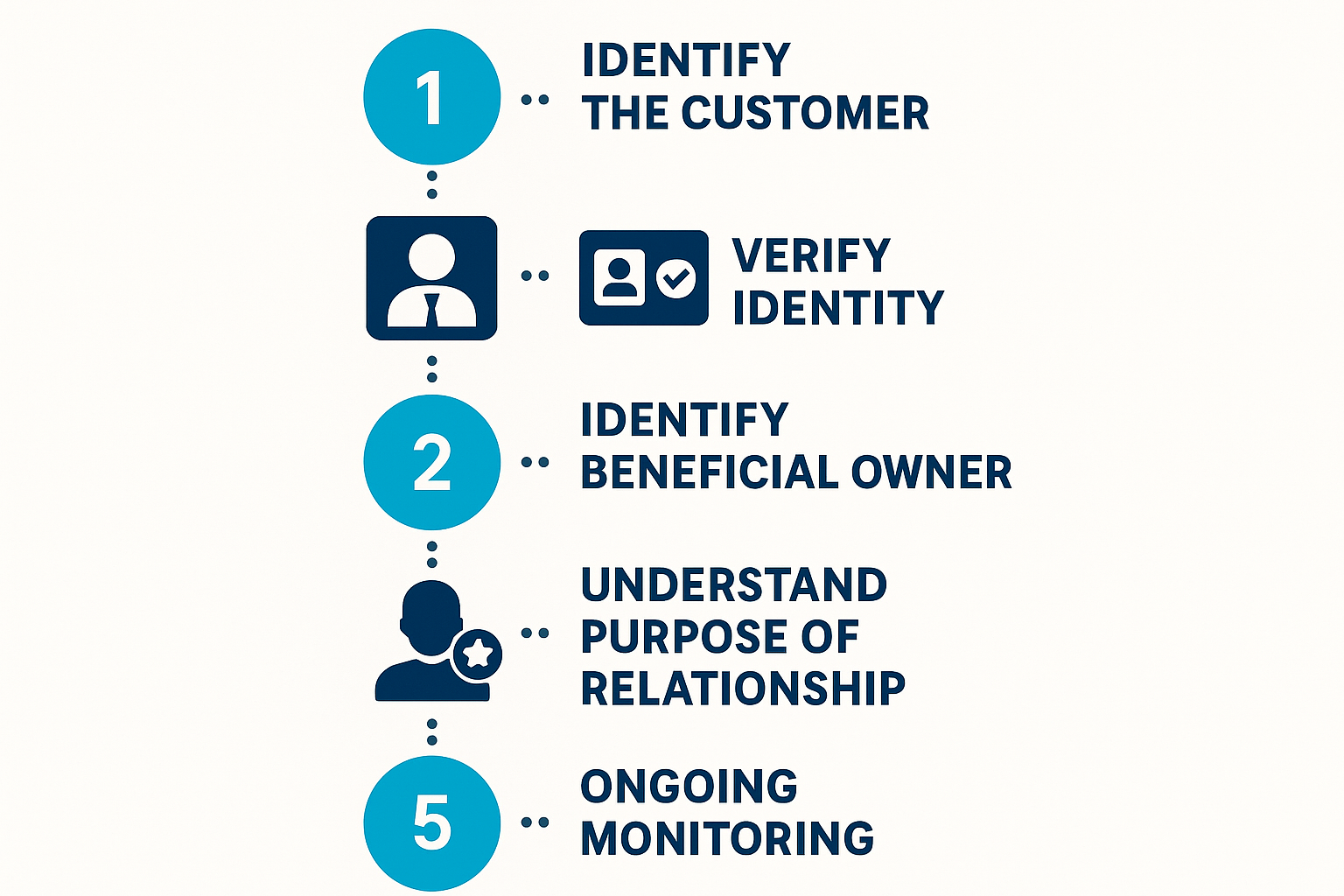
KYC Fundamentals
Know Your Customer
- The most important process in AML compliance
- Before you can protect the bank, you need to know who you are dealing with
CDD
What is Customer Due Diligence?
- Verifying identity of the customer
- Understanding the business relationship
- Assessing risk — a legal obligation under MLR and FATF
CDD
Four Triggers for CDD
- A new relationship
- A transaction of €15,000+
- A suspicion of money laundering
- Doubt about identification already held
Verification
Identity Verification Requirements
- Individuals: passport, driving licence, proof of address
- Legal entities: certificate of incorporation, articles, register of directors
- Address proof must be within three months
Beneficial Ownership
Identifying the True Owner
- Who owns or controls 25%+ of the entity?
- Following ownership chains through layered structures
- This is where criminals hope you will stop looking
Due Diligence Levels
Three Levels of Due Diligence
- Simplified — low-risk: listed companies, government bodies
- Standard — the default for most clients
- Enhanced — when risk demands more scrutiny
Enhanced Due Diligence
When EDD is Required
- Politically exposed persons (PEPs)
- High-risk jurisdictions (FATF Call for Action list)
- Complex structures and unusual transactions
Enhanced Due Diligence
Politically Exposed Persons
- Heads of state, ministers, senior judges
- Extends to family members and close associates
- Senior management approval required before proceeding
Enhanced Due Diligence
Source of Funds vs. Source of Wealth
- Source of funds: Where did the money for this transaction come from?
- Source of wealth: How did the customer build their fortune?
- Both require documented evidence
Ongoing Monitoring
CDD Does Not End at Onboarding
- Continuous monitoring of transaction patterns
- Measured against the customer's profile
- Any deviation demands investigation
Ongoing Monitoring
Events Requiring Immediate Review
- A police enquiry
- Adverse media coverage
- A filed SAR or sudden shift in transaction patterns
- Cannot wait for the next periodic cycle
Case Study
When Monitoring Fails: Stunt & Co
- £46.8M from a convicted launderer
- Police warnings ignored
- Five years without a proper review
Case Study
What Should Have Happened
- Immediate review when police made contact
- Dynamic risk reassessment
- Automated alerts and senior escalation
Your Role
Your Due Diligence Duties
- Verify every customer
- Monitor continuously
- Escalate if something does not look right
Your diligence is the first and most important line of defence.