Proceeds of Crime Act 2002 (POCA)
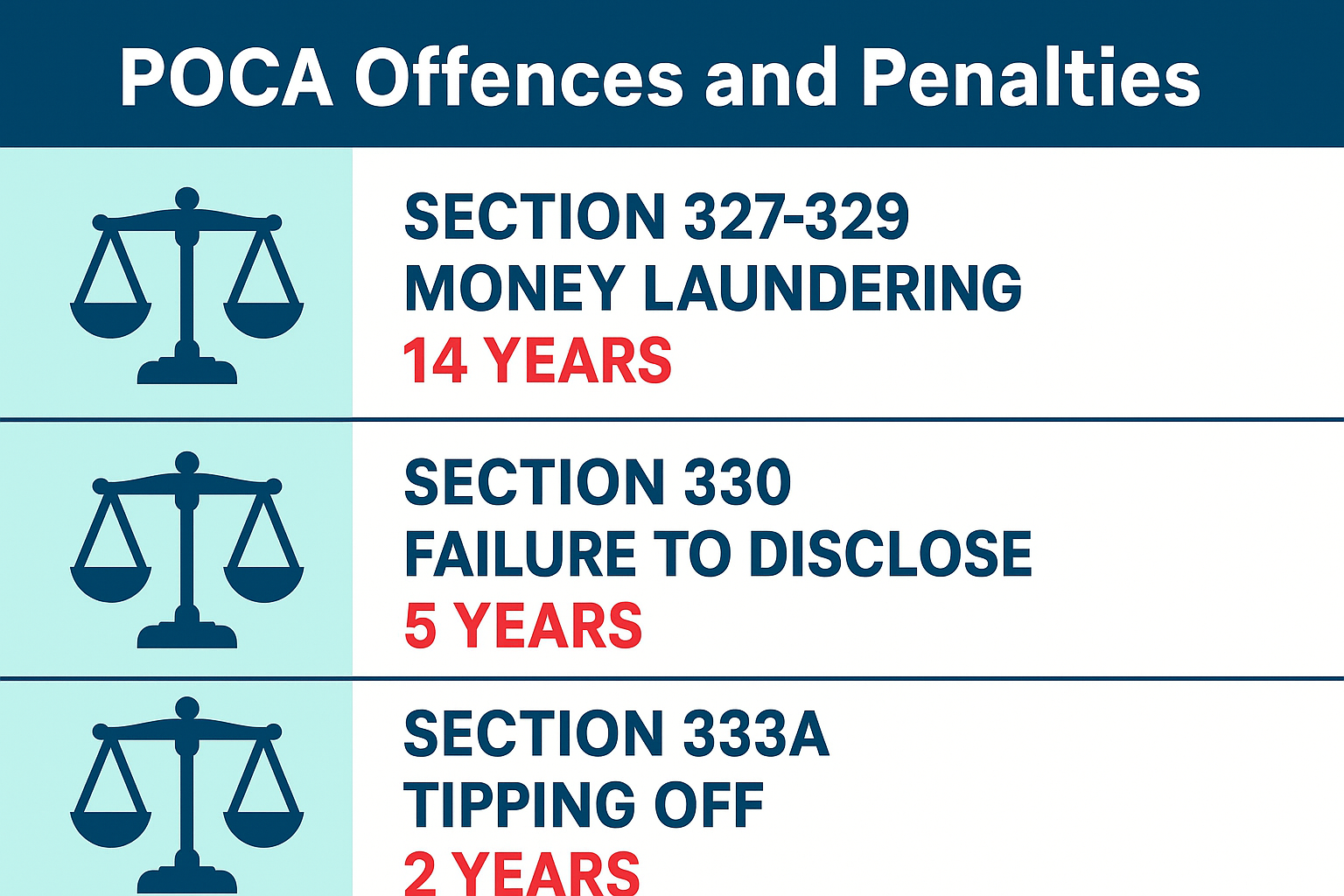
POCA is the cornerstone of UK anti-money laundering law. It creates three principal money laundering offences, a failure-to-disclose offence for the regulated sector, and a tipping-off offence (CPS Prosecution Guidance).
Principal Offences (Sections 327–329)
| Section | Offence | Description | Maximum Penalty |
|---|---|---|---|
| s.327 | Concealing etc. | Concealing, disguising, converting, transferring, or removing criminal property from the UK | 14 years' imprisonment |
| s.328 | Arrangements | Entering into or becoming concerned in an arrangement which facilitates the acquisition, retention, use, or control of criminal property | 14 years' imprisonment |
| s.329 | Acquisition, use, possession | Acquiring, using, or possessing criminal property | 14 years' imprisonment |
All three offences require that the property in question is "criminal property" — meaning it constitutes or represents a person's benefit from criminal conduct, and the alleged offender knows or suspects that it does (CPS Prosecution Guidance).
The prosecution does not need to prove what the specific predicate offence was. It is sufficient to show that the property was derived from some form of criminal conduct (CPS Prosecution Guidance).

Failure to Disclose (Section 330)
Section 330 applies specifically to the regulated sector (including banking). A person commits an offence if:
- They know, suspect, or have reasonable grounds to know or suspect that another person is engaged in money laundering; and
- The information came to them in the course of business in the regulated sector; and
- They do not make the required disclosure to their MLRO or directly to the NCA as soon as practicable.
Unlike the principal offences, which require actual knowledge or suspicion, s.330 can be breached where a person should have known or suspected — an objective test. A reasonable person in the same position would have been suspicious (CPS Prosecution Guidance).
Tipping Off (Section 333A)
It is a criminal offence to disclose to any person that a SAR has been made, is being contemplated, or is being considered — or that an investigation into money laundering allegations is being contemplated or carried out. The disclosure must be likely to prejudice the investigation. Maximum penalty: 2 years' imprisonment (CPS Prosecution Guidance).
Money Laundering Regulations 2017 (MLR 2017)
The MLR 2017 transposed the EU's Fourth and Fifth Money Laundering Directives into UK law and remain the primary regulatory framework for AML compliance. They apply to all firms in the regulated sector and set out requirements for (FCA):
- Risk assessments — firms must identify, assess, and document their ML/TF risks
- Customer due diligence — including simplified, standard, and enhanced due diligence
- Ongoing monitoring — of business relationships and transactions
- Record keeping — at least 5 years
- Internal controls — policies, procedures, training, and the appointment of a compliance officer
- Reporting — SARs to the NCA
2025 MLR Amendments
The UK Government published proposed amendments to the Money Laundering Regulations with several significant changes expected to come into force in early 2026:
- EDD narrowed: Enhanced due diligence requirements now apply only to countries on the FATF "Call for Action" list, reducing the compliance burden for business with many jurisdictions previously caught by EDD requirements.
- CDD carve-out for bank insolvency: Simplified due diligence provisions for certain insolvency scenarios.
- Pooled client accounts: Decoupled from simplified due diligence rules — firms can no longer assume SDD is appropriate for pooled client accounts.
- Crypto alignment: Crypto asset firms brought into closer alignment with FSMA registration requirements, tightening the framework for virtual asset service providers.
Economic Crime and Corporate Transparency Act 2023 (ECCTA)
The ECCTA introduced:
- "Failure to prevent fraud" offence: Large organisations can be criminally liable if an employee commits fraud intended to benefit the organisation, unless reasonable fraud prevention procedures were in place.
- Senior managers test: Expanded corporate criminal liability — the conduct of senior managers can be attributed to the organisation.
- Companies House reform: New identity verification requirements for company directors and beneficial owners, with powers to query and remove false information.
- Crypto seizure powers: Law enforcement can seize and recover crypto assets without first needing to arrest someone.
Sanctions and Anti-Money Laundering Act 2018 (SAMLA)
SAMLA provides the post-Brexit legal framework for UK autonomous sanctions regimes, independent money laundering regulations, and the legal basis for the Office of Financial Sanctions Implementation (OFSI).
Test Your Knowledge: POCA Penalties
Complete the sentences with the correct penalty or section number. You must get all six blanks correct to unlock the next module.