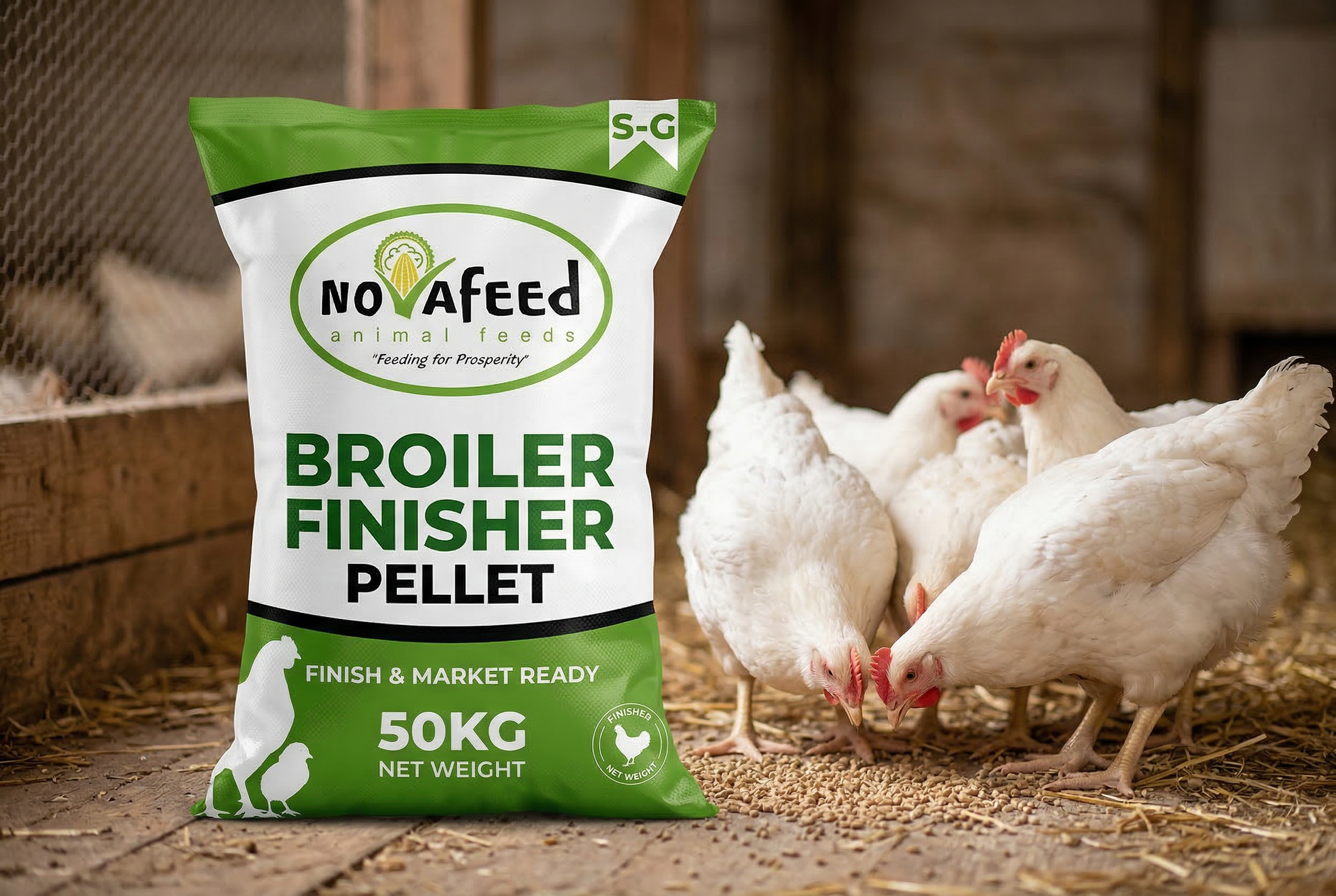
Switching to Finisher Feed
At approximately Day 28–30, transition from NovaFeed Broiler Grower Pellet to NovaFeed Broiler Finisher Pellet. The Finisher has the lowest protein (typically 18–19%) and highest energy content, designed to put on maximum weight in the final stretch. As with all transitions, mix 50/50 for a day or two.
Feed consumption peaks during Weeks 4–6, with individual birds eating 100–170 grams per day. This is the most expensive phase of the entire growing cycle — approximately 4 bags (100 kg) of Finisher will be needed for 100 birds.
Total Feed Budget — 100 Birds, 6-Week Cycle
| Feed Phase | NovaFeed Product | Duration | Bags (25 kg) | Est. Cost (USD) |
|---|---|---|---|---|
| Starter | Broiler Starter Crumble | Days 1–14 | 1 | ~$33 |
| Grower | Broiler Grower Pellet | Days 15–28 | 2 | ~$66 |
| Finisher | Broiler Finisher Pellet | Days 29–42 | 4 | ~$124 |
| Total | 42 days | 7 bags (175 kg) | ~$223 |
Source: Shambani College — Cost Analysis
Understanding FCR (Feed Conversion Ratio)
FCR is the single most important efficiency metric in broiler farming. It tells you how many kilograms of feed it takes to produce one kilogram of live weight gain.
How to calculate FCR: Total feed consumed (kg) divided by total live weight gained (kg). For example, if your 100 birds consumed 175 kg of feed and gained a total of 110 kg in body weight, your FCR is 175 / 110 = 1.59 — that is excellent (The Big Book Project).
| FCR Range | Rating | What It Means |
|---|---|---|
| 1.5–1.8 | Good | Efficient conversion; you are on track for profit |
| 1.8–2.0 | Acceptable | Room for improvement but still viable |
| Above 2.0 | Problem | Investigate feed waste, disease, or environmental stress |
Improving FCR from 2.5 to 1.5 can reduce feed expenses by approximately 40%, cutting overall costs by roughly 28%. This is the biggest lever you have for increasing profit.
Market Preparation
Withhold feed for 6–8 hours before slaughter or sale to empty the digestive tract. Continue providing clean water. This produces a cleaner carcass and is standard practice across all commercial operations (EntrepreneursHub).
Handle birds gently in the final days. Rough handling causes bruising, which reduces carcass quality and selling price. Catch birds by both legs, not by the wings. Transport in well-ventilated crates, never stuffed into sacks.
Think About It
You calculate your FCR at 2.3. Something is wrong. What could be causing poor feed conversion?
- Feed waste — feeders set too low, allowing birds to scratch feed onto the litter
- Disease — subclinical infections (e.g., coccidiosis) reduce nutrient absorption
- Temperature stress — birds in cold conditions burn calories to stay warm instead of growing
- Water restriction — dehydrated birds eat less and convert feed poorly
- Overcrowding — stressed birds are less efficient; dominant birds eat more, weaker ones less
Identifying the cause is the first step. Fixing FCR is often the difference between profit and loss.
Check Your Understanding
For each statement, decide if it is True or False.
1. An FCR of 2.5 means excellent feed conversion efficiency.
2. Feed should be withdrawn 6–8 hours before selling to empty the digestive tract.
3. The Finisher phase is the cheapest part of the feeding program.